
Taxonomy Browser
Taxonomy
The taxonomy is the catalogue describing what information can be stored in the reports and how this information is encoded in the data fields.
The ECCAIRS2 Taxonomy is publicly available and serves as the standard reference for all Occurrence Reports. Users can access the latest published version without registration. Additionally, Authorities may create custom taxonomies with tailored attributes, entities, or value lists, which require user registration to view.
Accessing the Taxonomy
To access the Taxonomy Browser you can follow this link: Taxonomy Browser.
Alternatively, you can access the Taxonomy Browser directly from the E2 Central Hub homepage:
- Click on 'REPORT AN OCCURRENCE' and then select 'Taxonomy' from the top menu:
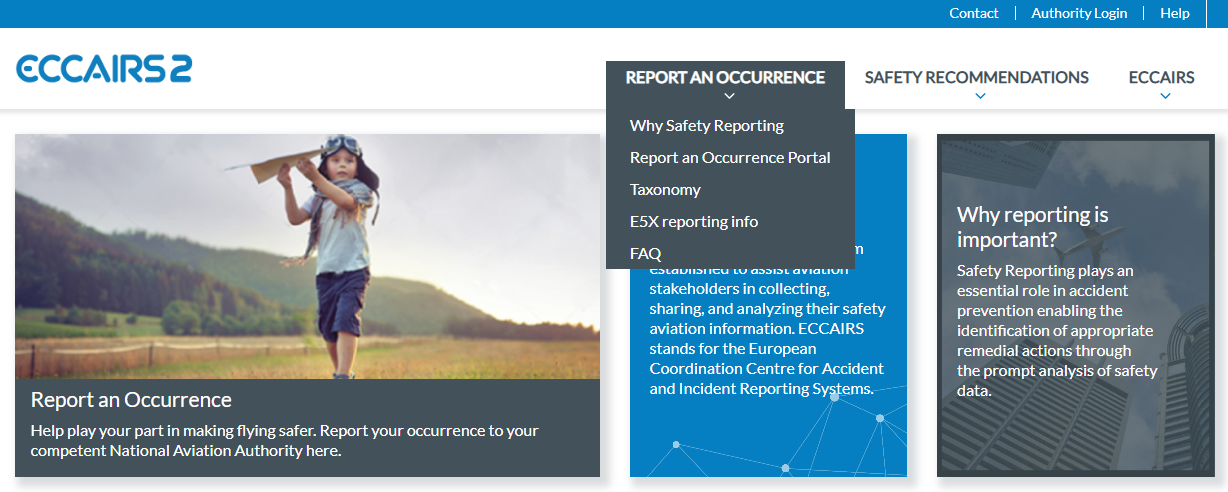
The system will display the ECCAIRS Taxonomy page with a link to the Taxonomy Browser:

-
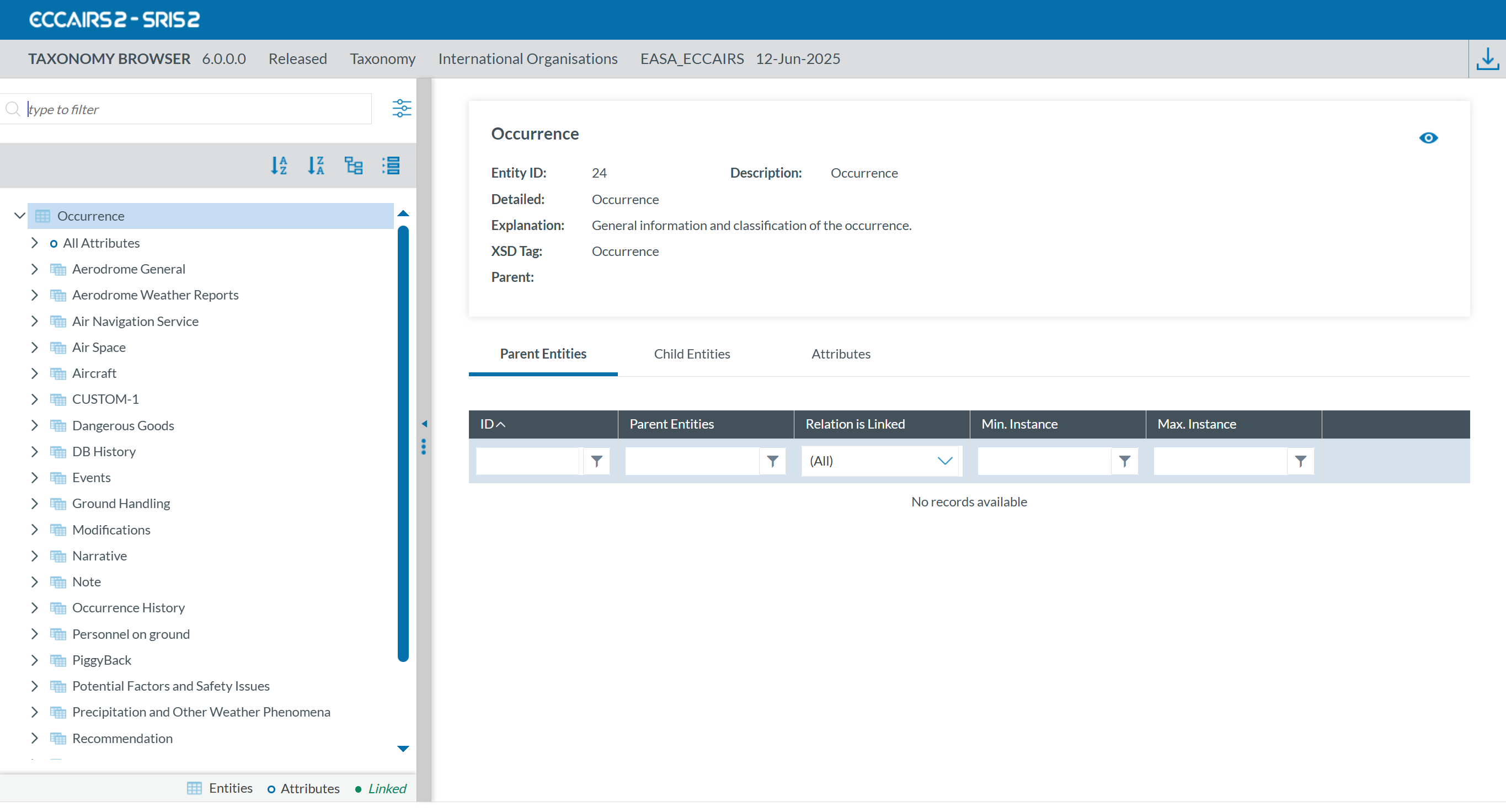
Click on 'Taxonomy Browser'. You will be redirected to:
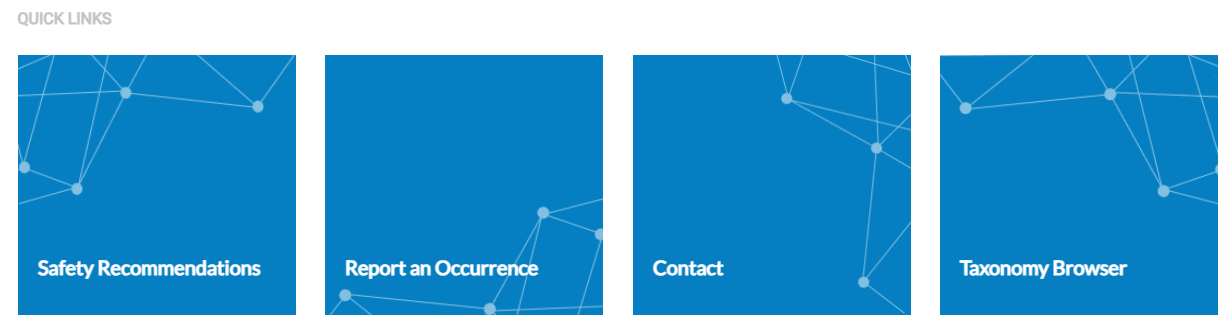
Quicklinks are also available at the bottom of the ECCAIRS Taxonomy page:
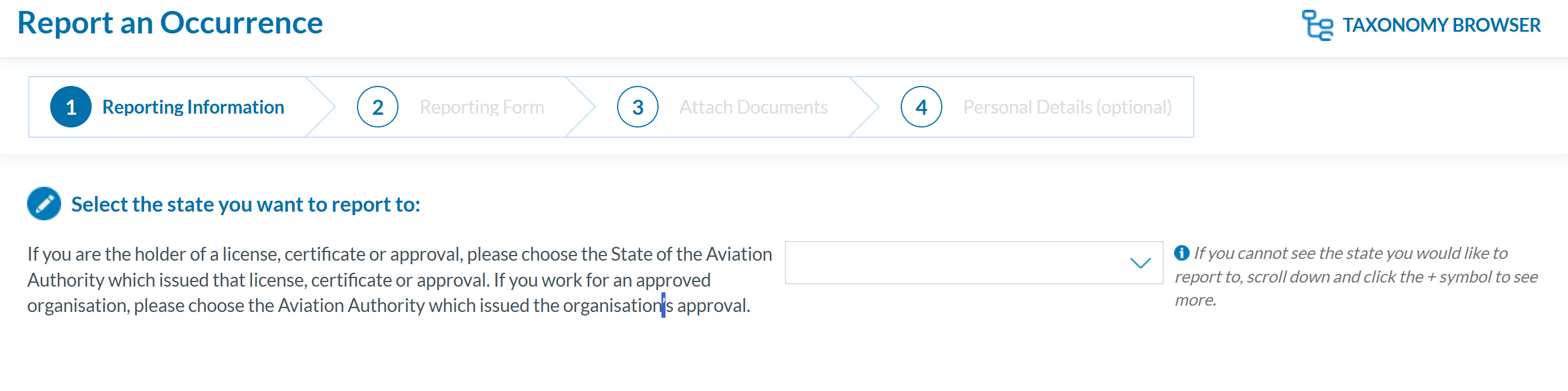
The Taxonomy Browser is also accessible via the link located at the top right corner of the 'Report an Occurrence' page.':
Taxonomy Browser
The Taxonomy Browser is a feature that organizes the entire ECCAIRS Taxonomy into a structured format, enabling easy navigation through its elements. For individual users or organizations, it is intended solely for consultation purposes.
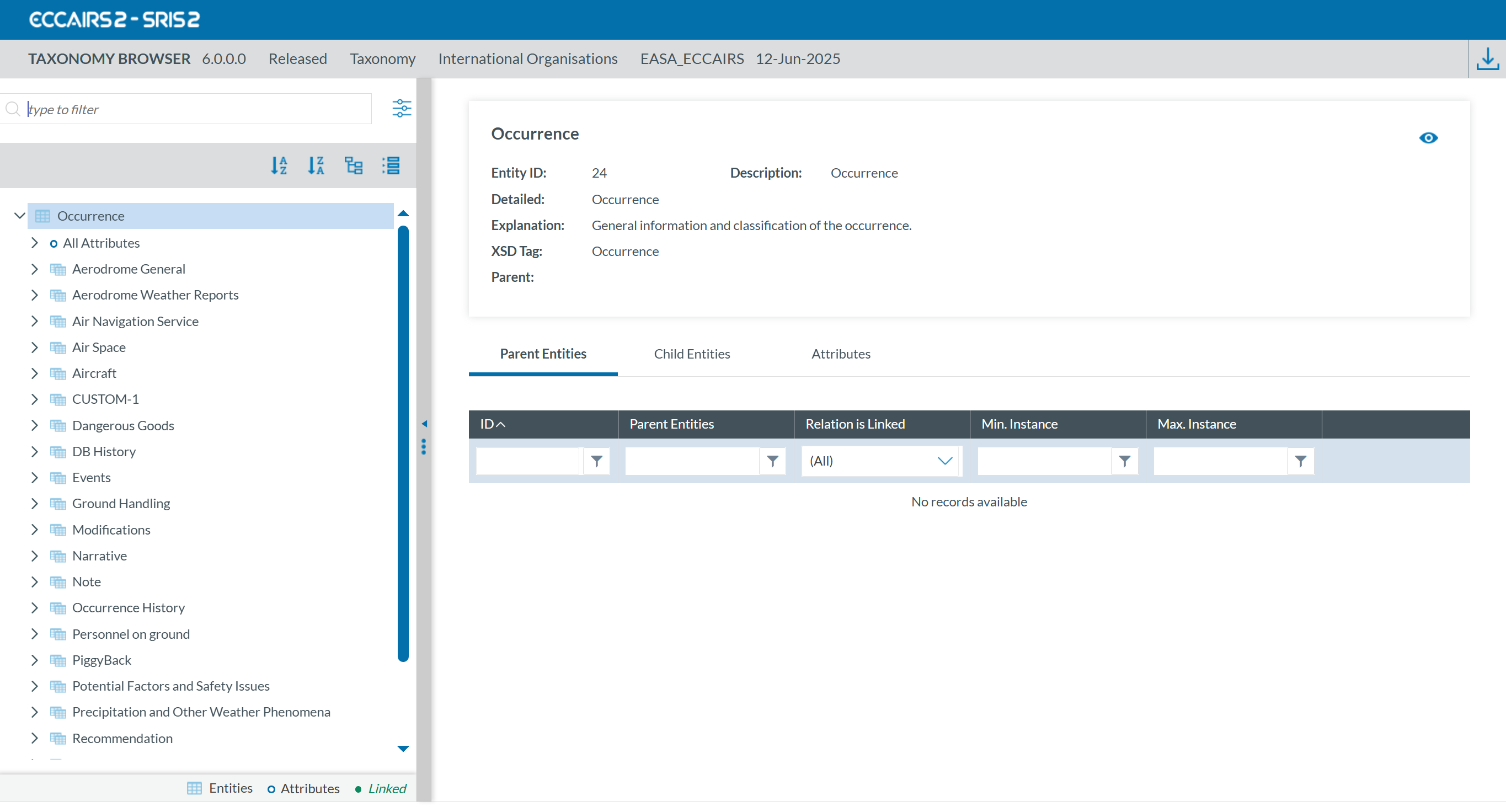
The taxonomy tree and the search bar are displayed on the left side of the screen. You can hide them by clicking the 'arrow' icon.

The left panel is resizable by clicking the 'three dots' icon

and dragging it left or right.
Search
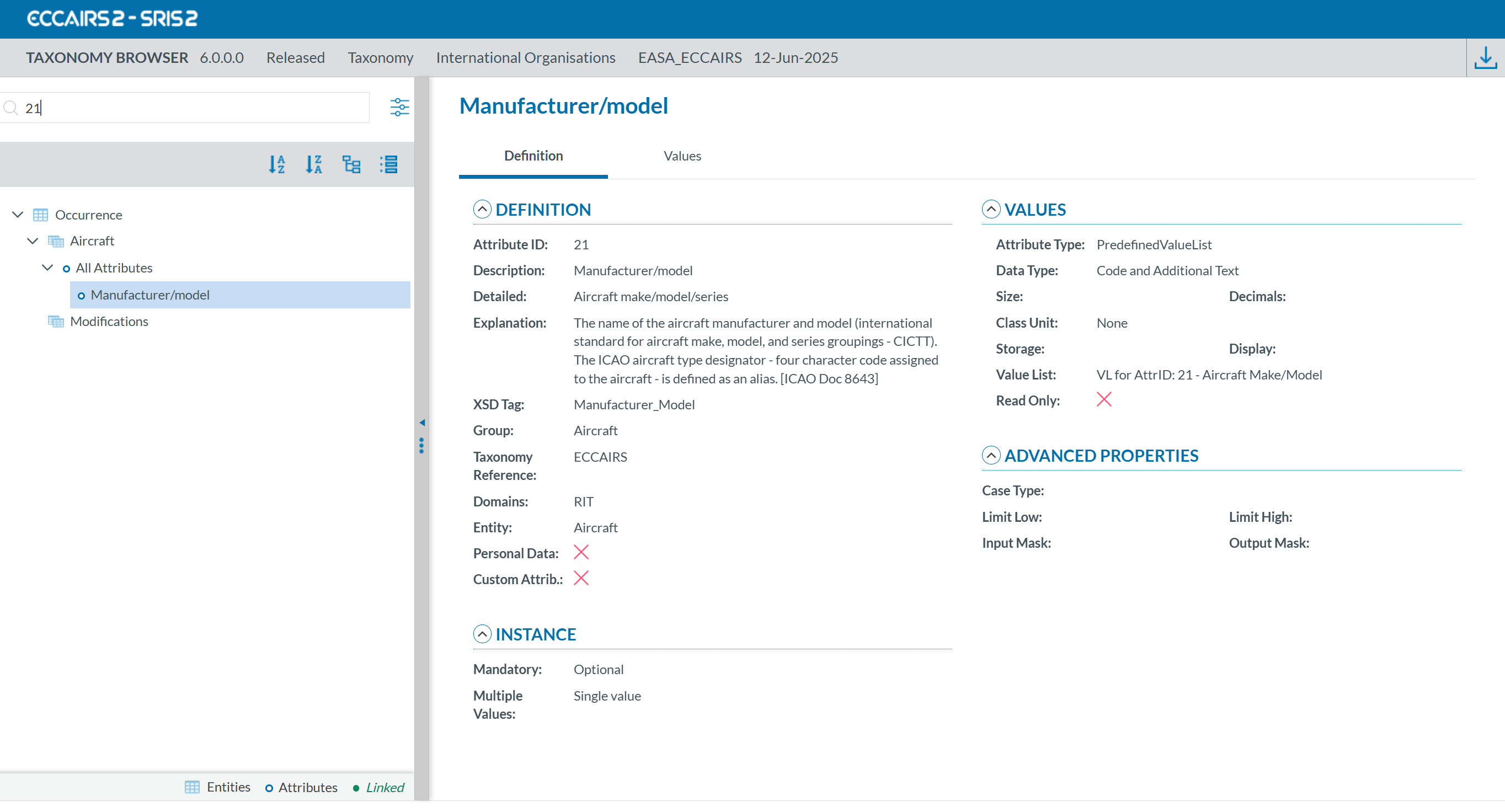
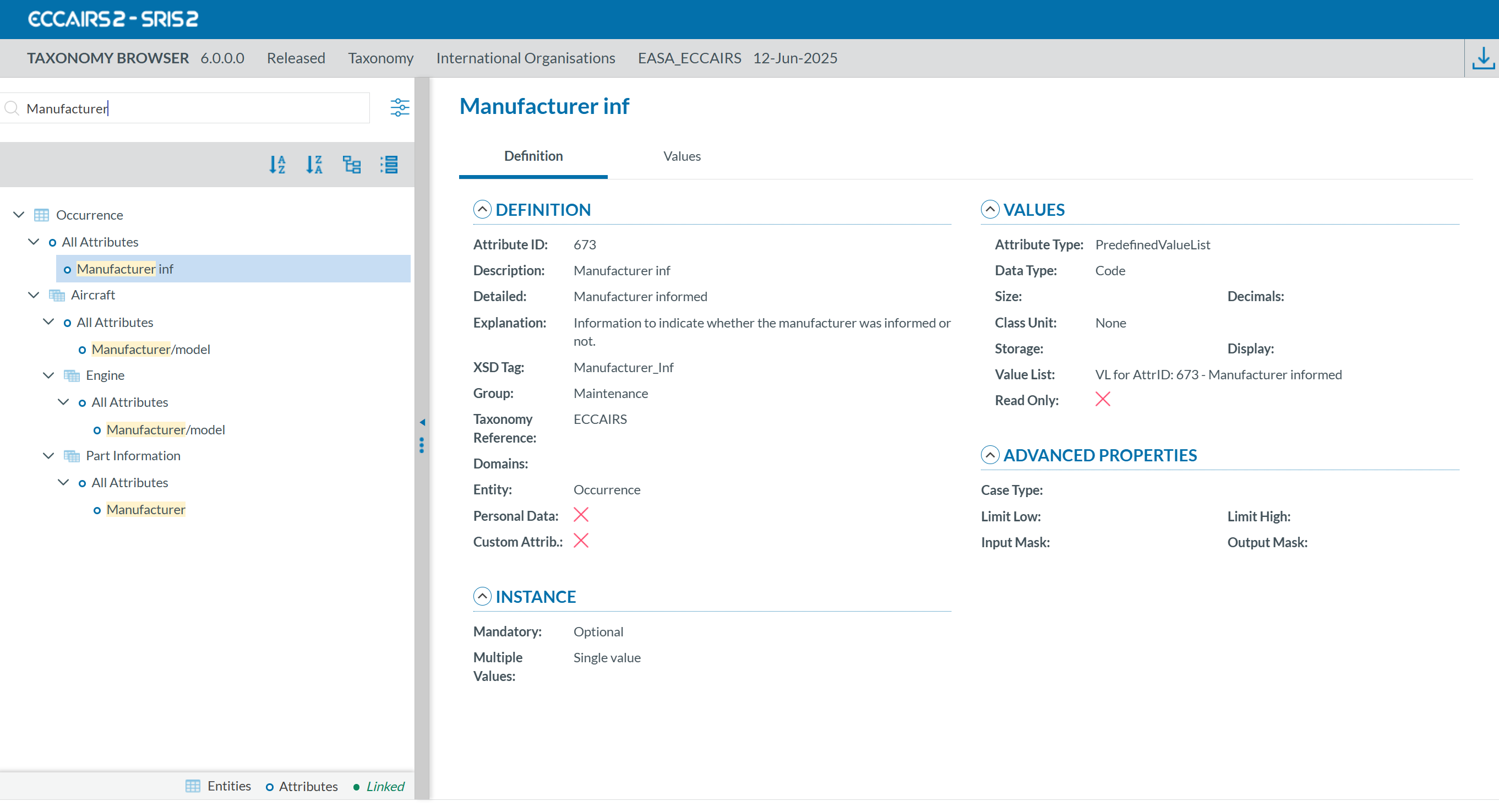
Entities and attributes can be found by entering the taxonomy code or description in the search box located at the top left.
For example, if you search by Taxonomy Code using '21':
If you search by description using 'Manufacturer':
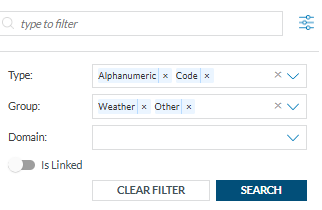
If you click on the 'Filter' button: , a layer with more filters will be displayed.
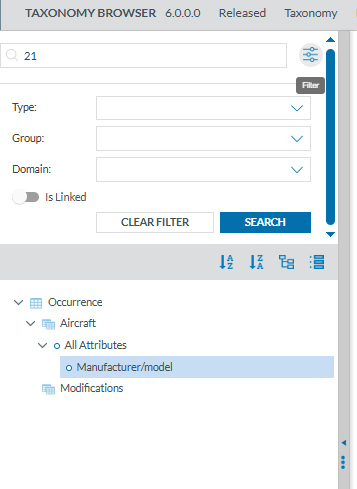
For each filter you can select one or more values. When you have finished click on 'SEARCH' to refresh the tree with your filters.
The Taxonomy Tree can be ordered alphabetically by clicking on the 'A-Z' icon or 'Z-A' icon :

You can collapse or expand all item of the Taxonomy Tree with the following buttons:
- Expand all

- Collapse all


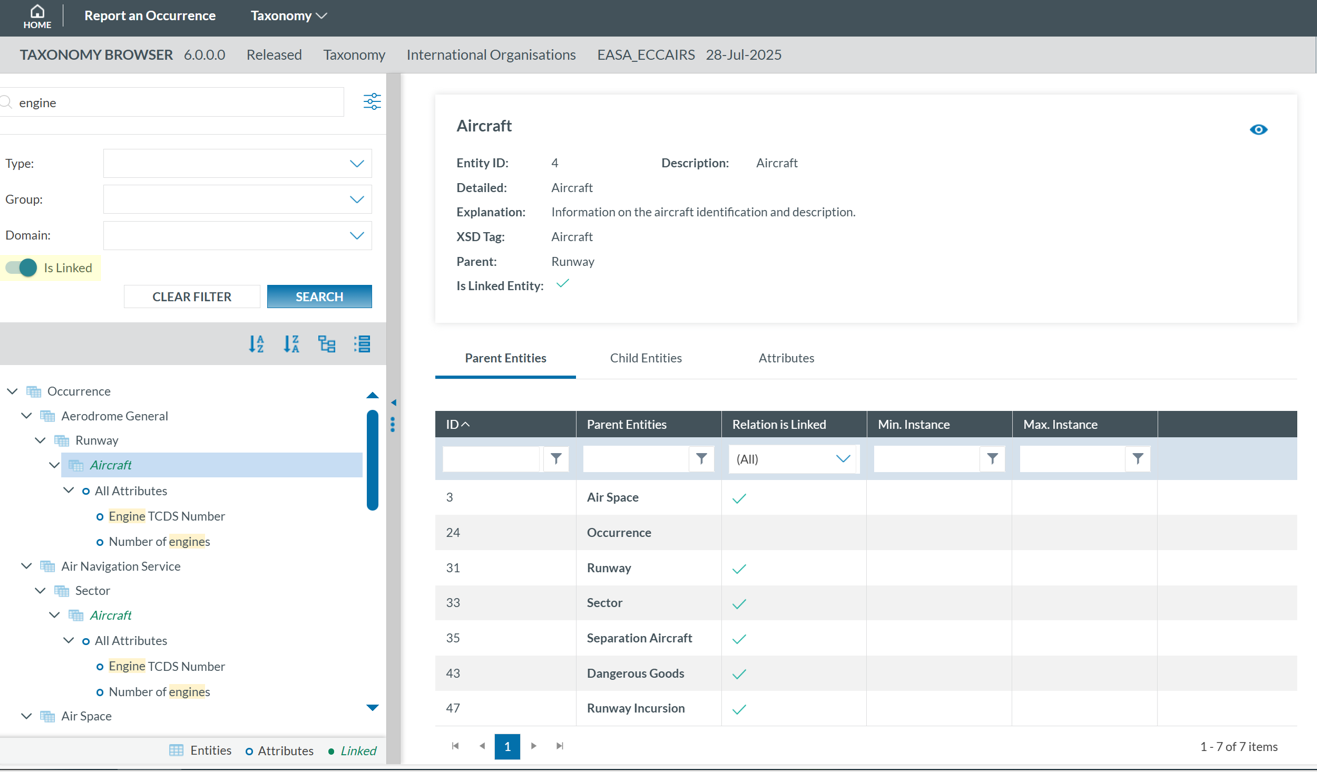
When an entity is a Linked Entity, it is highlighted in green in the Taxonomy Tree with the toggle switch:
Taxonomy structure
ECCAIRS taxonomy elements are structured as follows:
Entities
Attributes
Value Lists
Values
Entities
Entities represent items to which specific attributes are assigned—for example, an “Aircraft” involved in an incident or the associated “Events” description.
Multiple instances of an entity may exist when several items are involved (e.g., multiple aircraft in a single incident).
Entities can have child entities (e.g., an “Engine” belonging to an “Aircraft”).
Entities may also be linked to other entities (e.g., “Airspace” or “Aerodrome” where the “Aircraft” is operating).
Entities information
Entities in the Taxonomy Tree are represented by  or
or  .
.
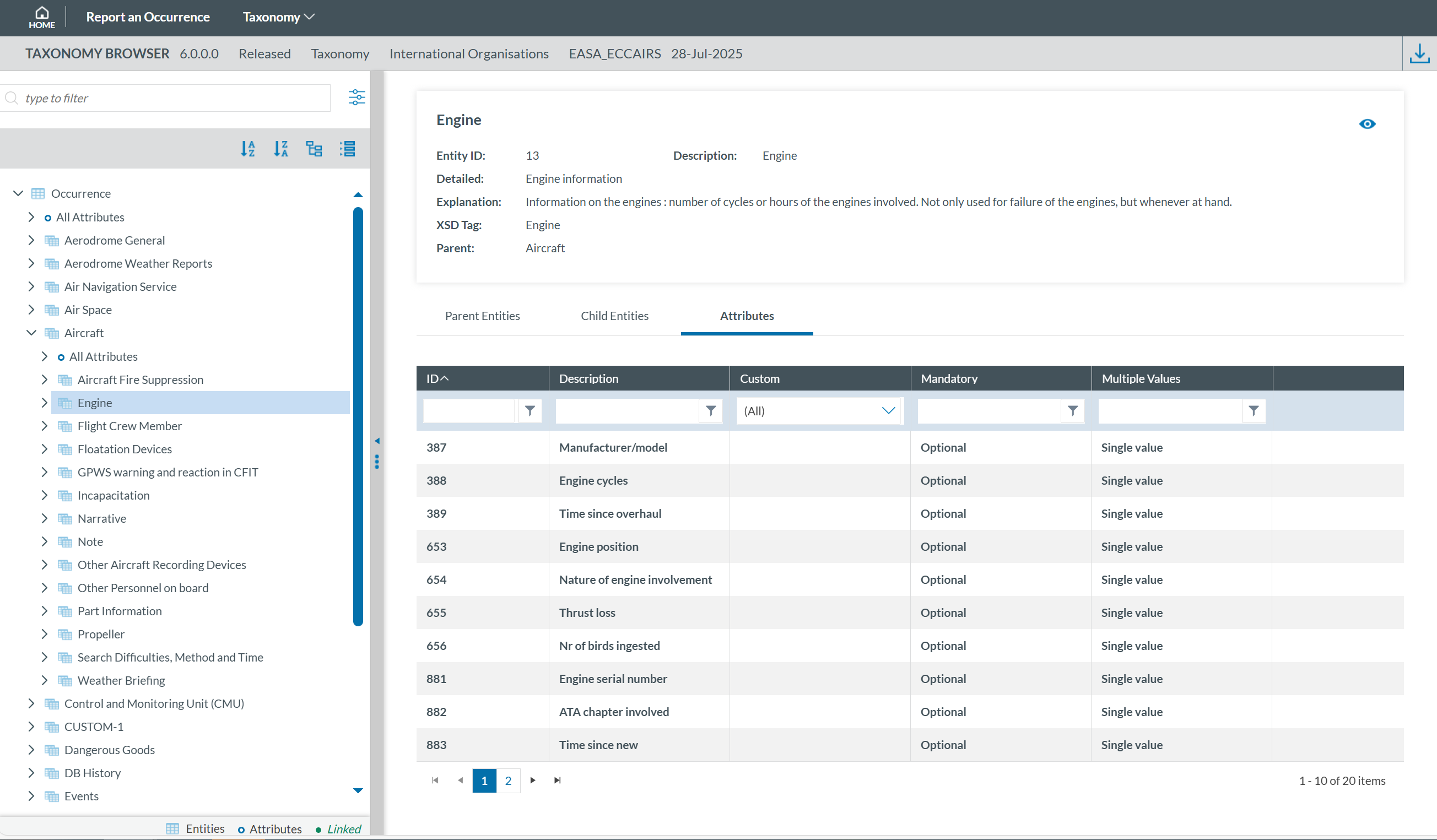
The following information will be displayed in the right side of the screen when you click on an Entity in the Taxonomy Tree:
Entity information: A brief summary of the selected Entity.
Parent Entities: The list of its parent Entities
Child Entities: The list of its children Entities
Attributes. The list of its Attributes
Click on each tab (Parent Entities, Child Entities, Attributes) to view its information.
Clicking the 'eye' icon  you can see detailed information from the entity.
Attributes
Attributes describe properties/values associated to an entity and represented by  . An example of an attribute of the “Aircraft” entity is its "manufacturer/model". Attributes may have either single or multiple values and can be of the following types:
Number
Decimals
Text
Alphanumeric
Date
Time
DateTime
Longitude
Latitude
Code
Code and Additional Text
Code or Alternative Text
ECCAIRS Resource Locator
ECCAIRS Data Link
ECCAIRS Embedded Data
Attributes information
Attribute information can be viewed from two locations within the Taxonomy Browser:

Select the entity to which the attribute belongs in the Taxonomy Tree (1), then click the 'Attribute' tab in the right-hand pane (2). Finally locate the attribute in the list and click the 'eye' icon  to view its detailed information (3):
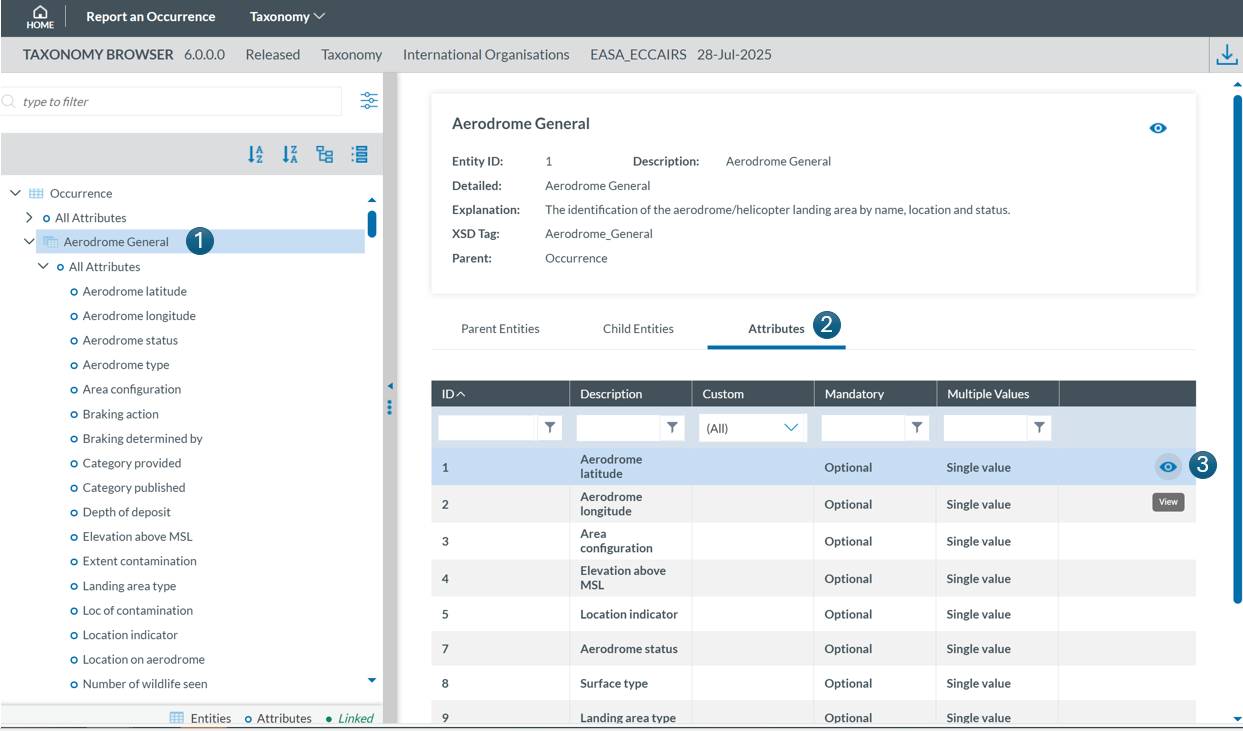
The information will be displayed:
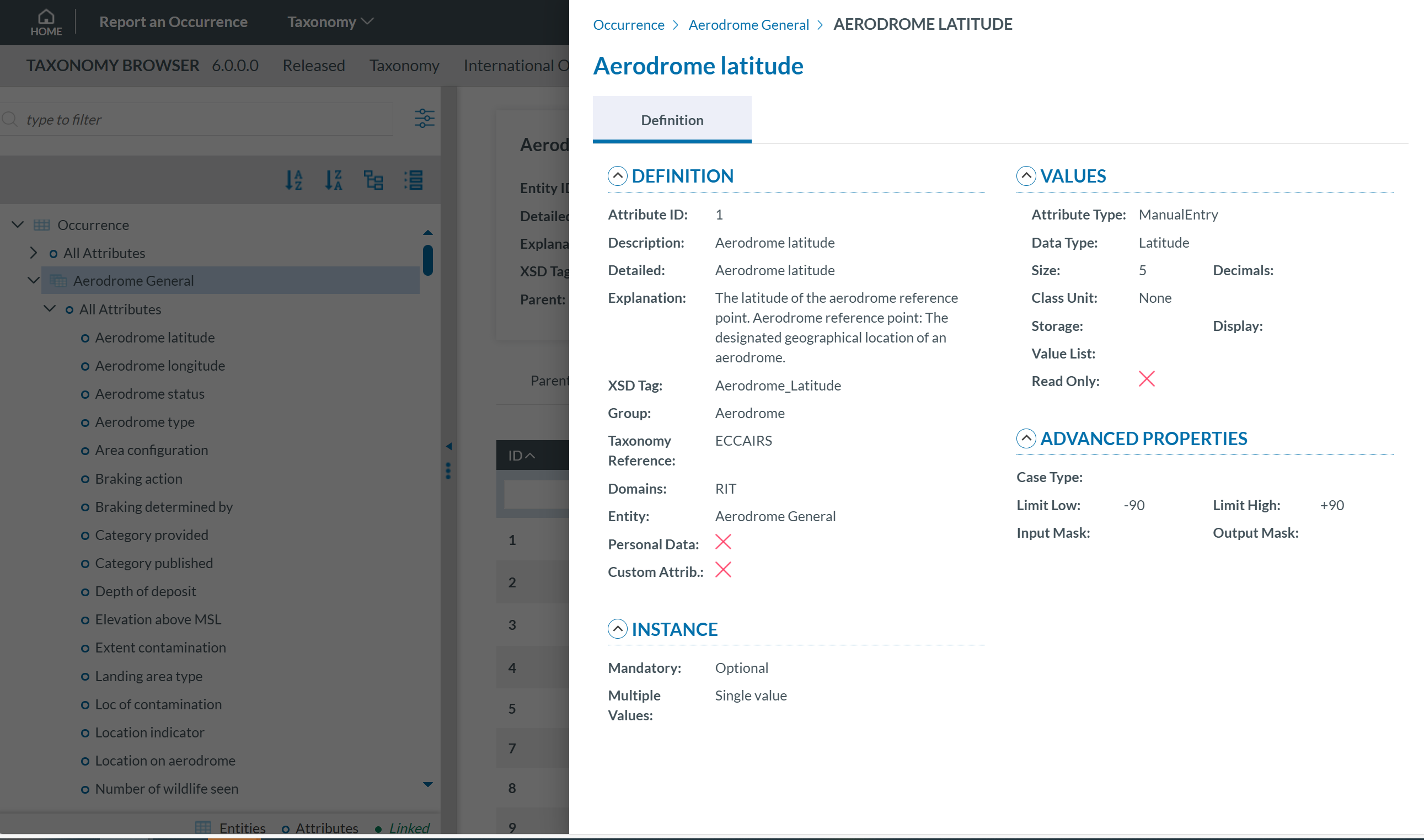
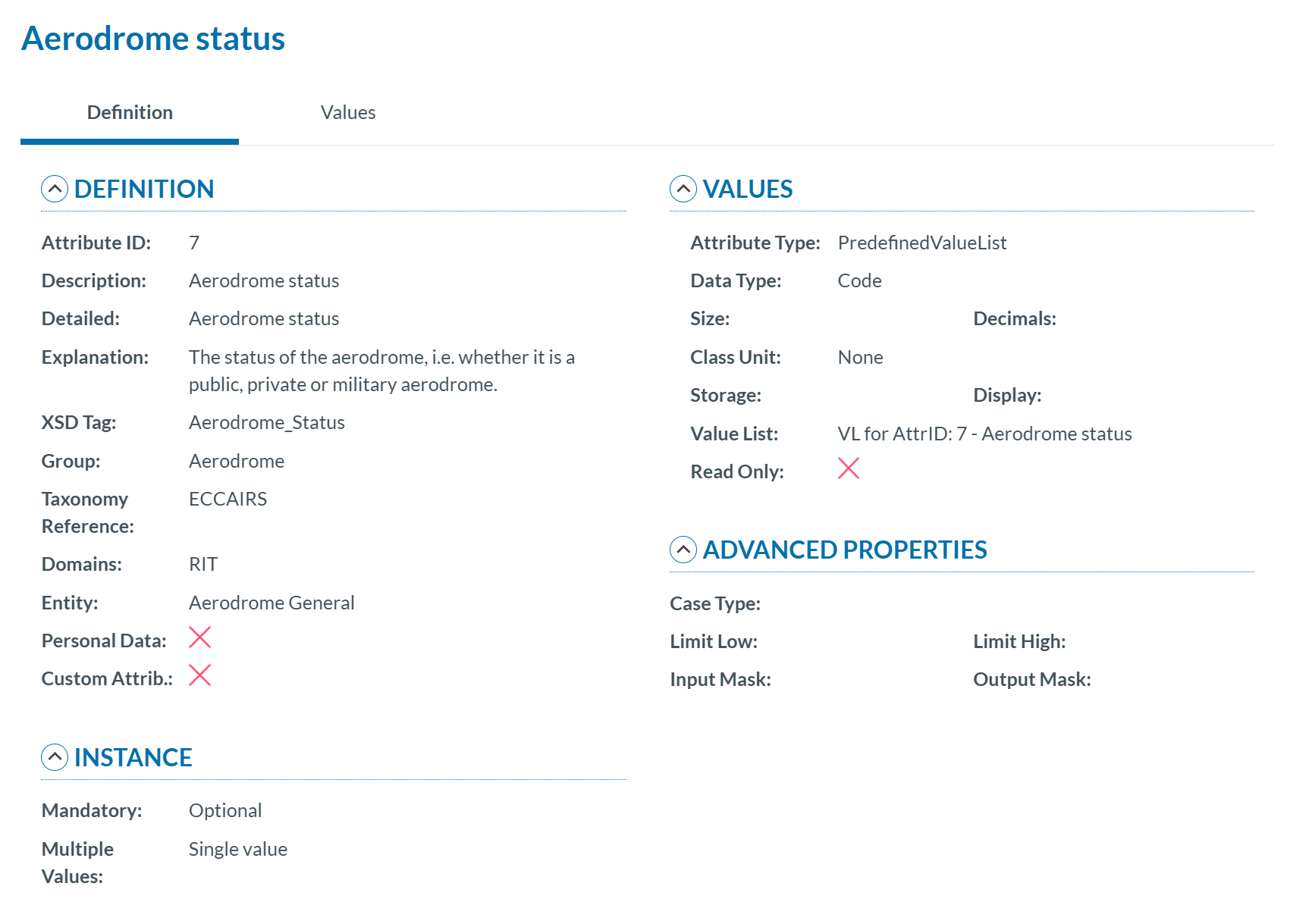
Attribute information may be displayed across two tabs:
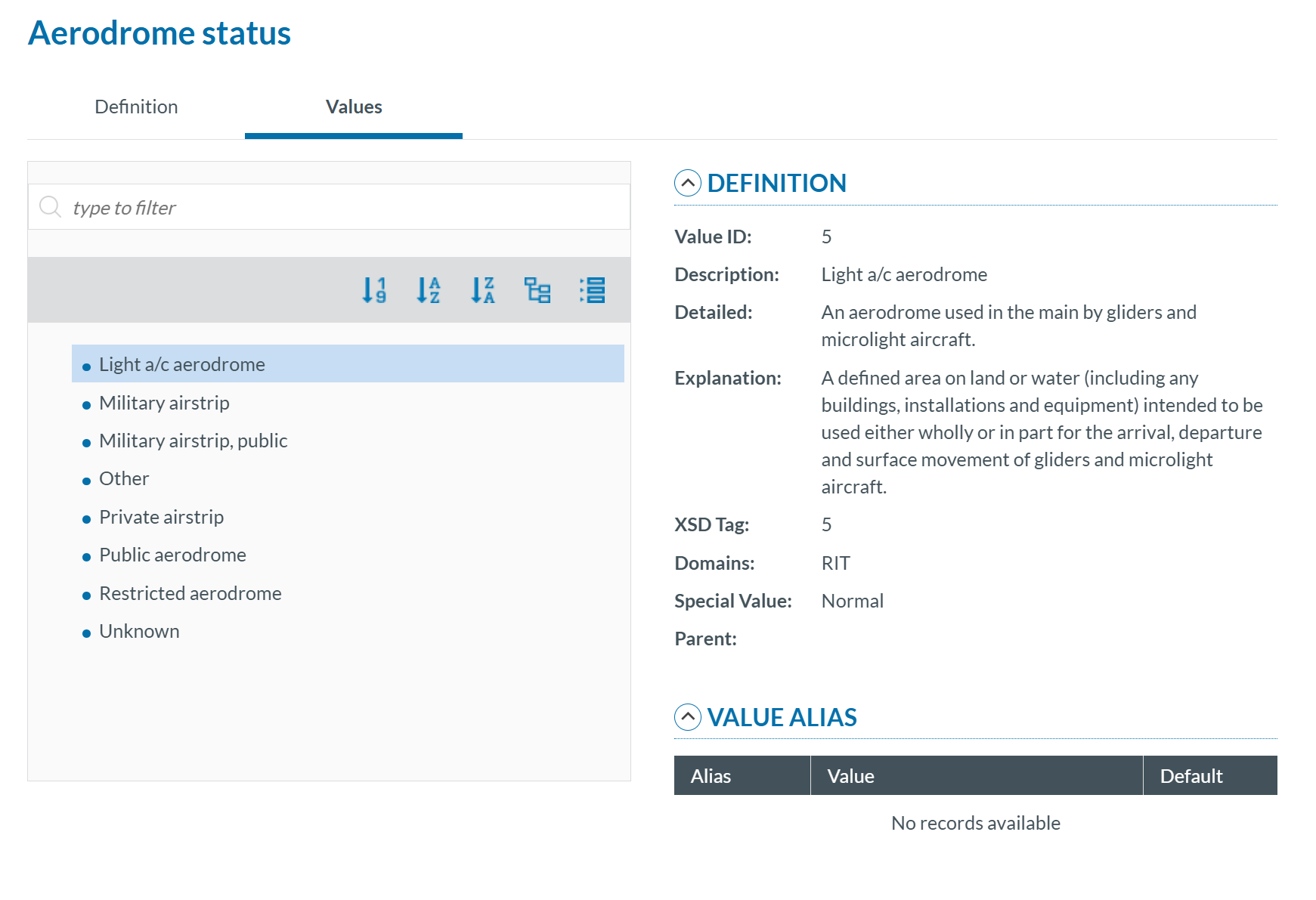
Value Lists
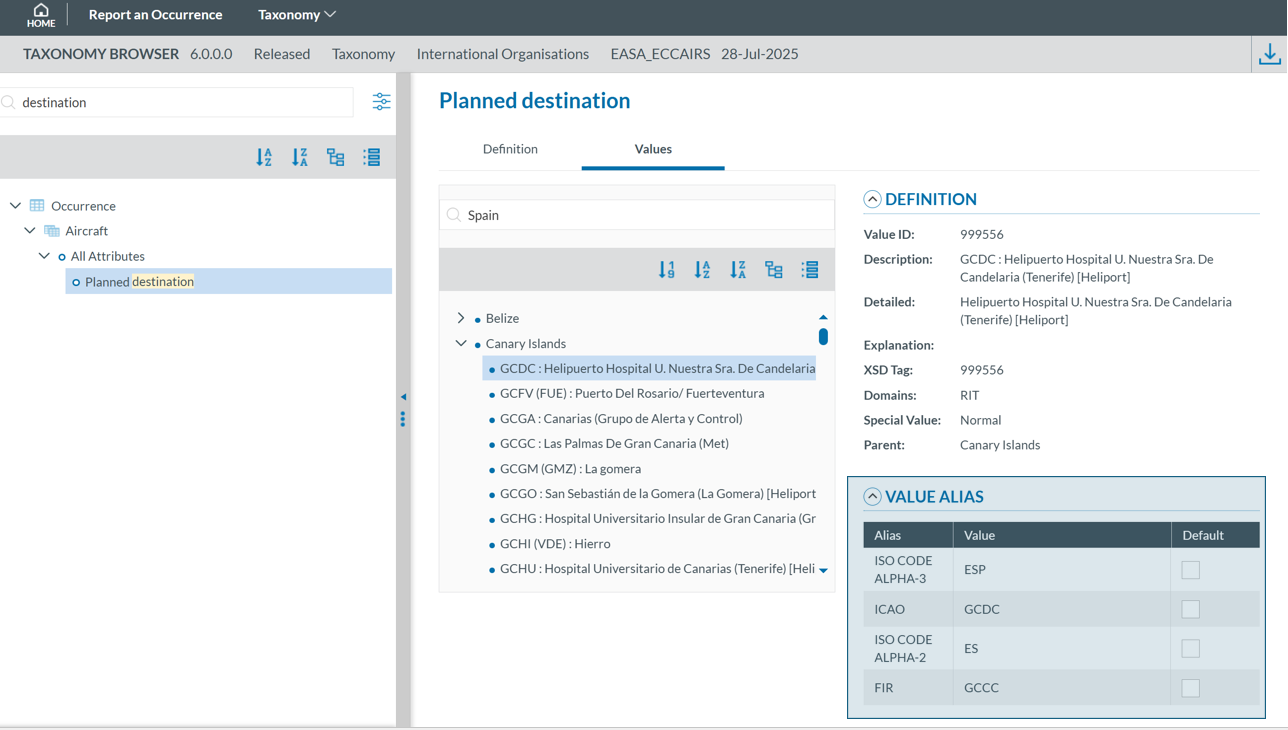
The list of values an attribute can have is defined in a Value List. The Value List can have multiple level where values are organized in a tree mode.
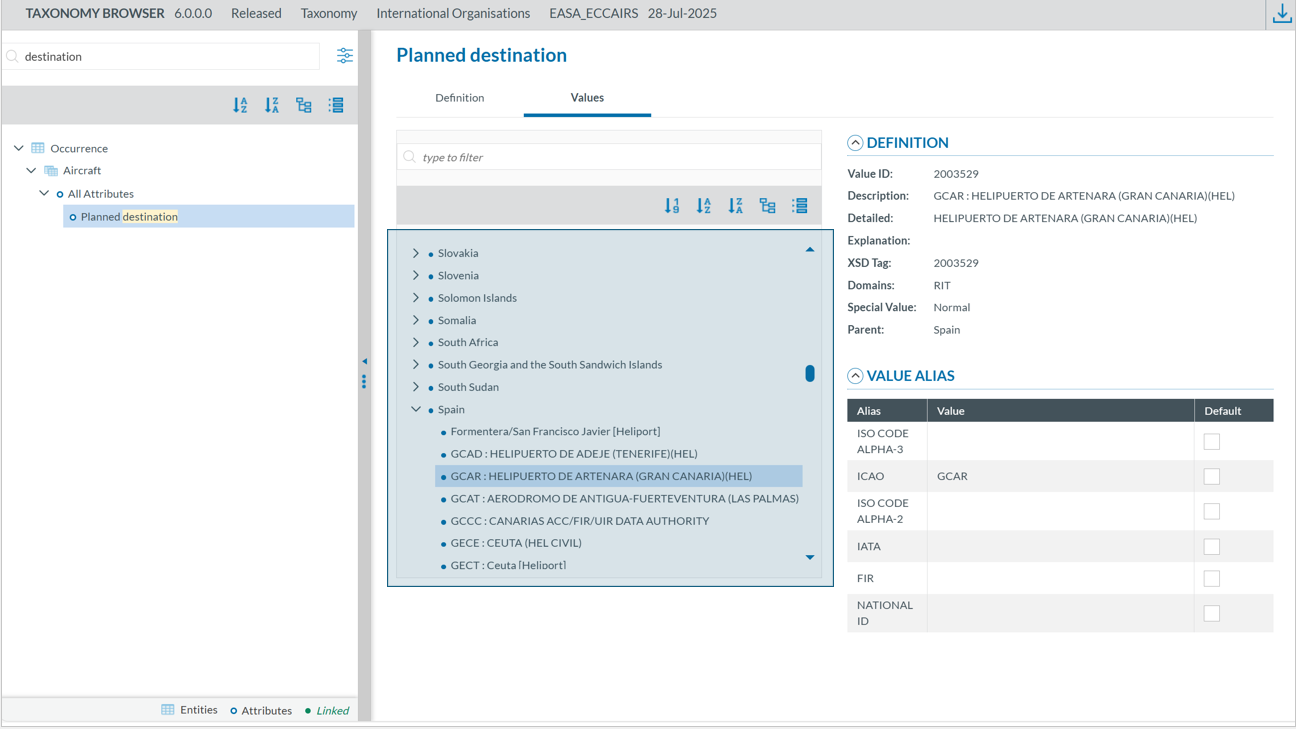
Value list can have Alias:
Values
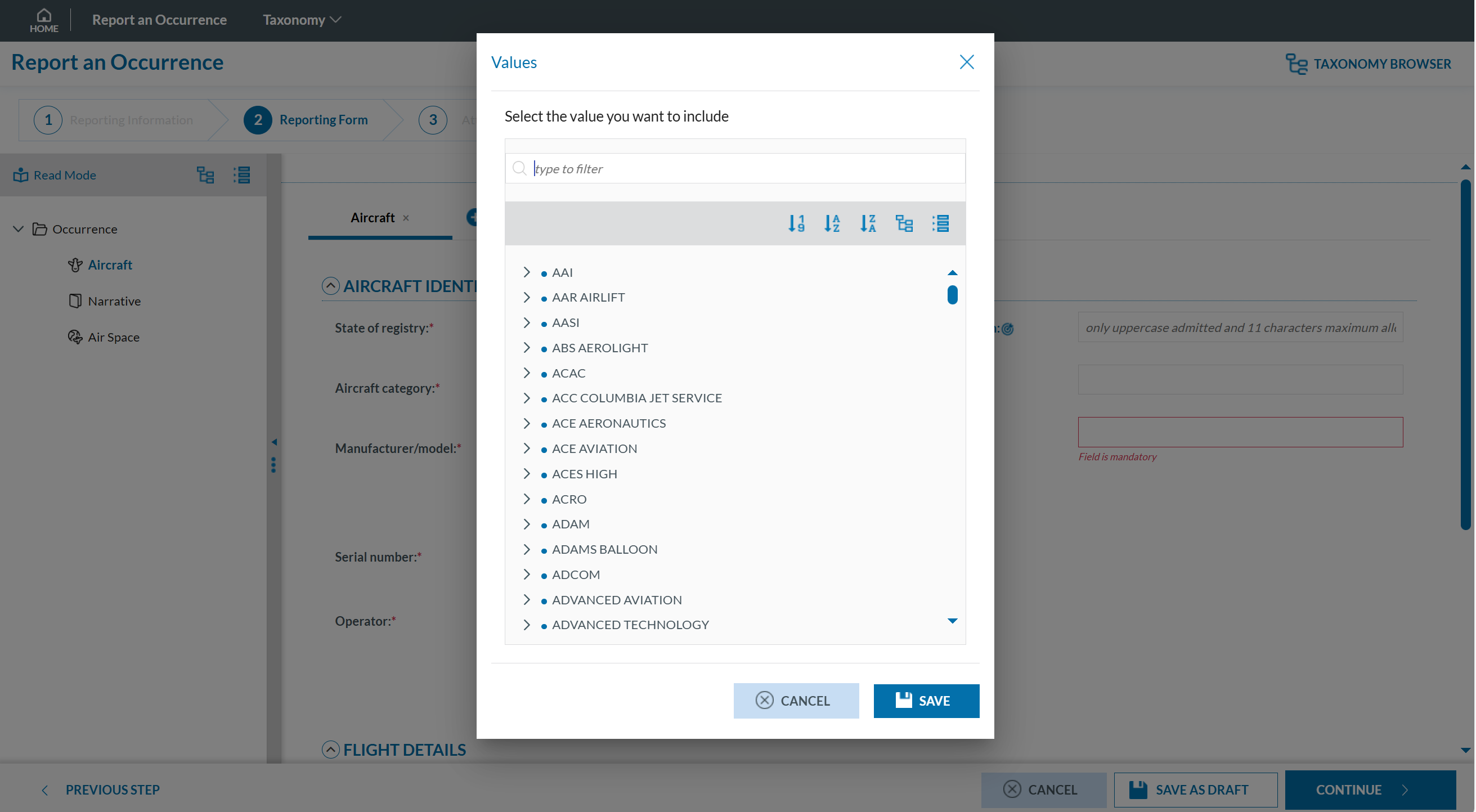
Depending on the attribute type, values may either be manually entered or selected from a predefined list (Value List). For example, for the Manufacturer/Model of an aircraft, a value can be chosen from a Value List:
However, for the Location Name attribute, values must be entered as free text only:

Filter the information
You can filter the Parent Entities, Child Entities and Attributes table by typing the term to be searched in the filter row. You can restrict the results by clicking the 'filter' icon  To delete the filter, you must click the
  'clear filter' icon.
By default, the 'contains' condition is selected:
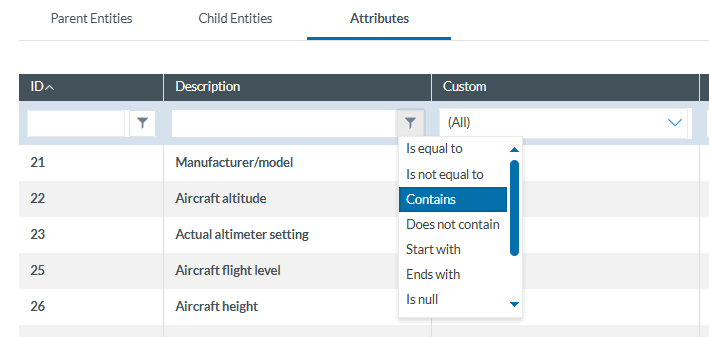
The filter options are:
Is equal to: the filter will look for fields that match the exact same string
Is not equal to: the filter will avoid the fields that match the exact same string
Contains: the filter will display all the fields that have the string written in any position
Does not contain: the filter will display the fields that do not have the string written in any position
Start with: the filter will look for the string at the beginning of the field
Ends with: the filter will look for the string at the end of the field
Is null: field does not exist
Is not null: field exists
Is empty: fields exist but does not have information
Is not empty: field exists and has information